
The Same Warm Floors.None of the Gas.
Thermal Dawn replaces your gas boiler with a solar-charged hydronic heat pump and thermal storage, heating your home through your existing pipes, radiators, and underfloor circuits, powered by energy you've already generated.
Your Hydronic System Already Works. Here's What We Change.
A hydronic system heats your home by circulating warm water through radiators, underfloor circuits, or fan coil units. The water gets hot, gives up heat to the room, returns cooler, gets reheated, and the cycle continues.
Your gas boiler has been doing that job reliably for years. The problem isn't the hydronic system, it's the heat source. Gas is expensive, it's getting more expensive, and it produces emissions every time it fires.
Thermal Dawn replaces just the heat source. Your pipes, your radiators, your zones, your thermostats, all stay exactly as they are. We connect our system where your boiler was, and from that point on your home is heated by stored solar energy instead of burning gas.
Why a Standard Heat Pump Isn't Enough
Swapping your gas boiler for a standard hydronic heat pump is an improvement, but it leaves a fundamental problem unsolved.
Your home needs heat most at dawn and dusk. That's when your family is home, when outdoor temperatures are lowest, and when your hydronic system works hardest. It's also exactly when electricity prices peak and your solar panels aren't generating.
A standard heat pump draws from the grid during those expensive hours. You've escaped gas, but you're still buying peak-rate electricity every morning and evening to keep your home warm.
The gap between when your solar generates and when your home needs heat is the problem Thermal Dawn is designed to solve.
Store the Sun. Heat with It Later.
Thermal Dawn adds thermal storage to the equation, a purpose-built insulated tank that holds heat energy, not electricity. During the day, your solar panels power our heat pump to charge that tank, raising the water temperature while your panels are generating and grid prices are low.
When your family comes home in the evening and your hydronic system kicks in, it draws from that stored thermal energy, not the grid. Your radiators and underfloor circuits run exactly as they always have. The only difference is the energy powering them cost you almost nothing.
What's Happening in Your System, Hour by Hour
This isn't imported technology we're reselling. Thermal Dawn is designed for 45°C summers and single-digit winters, using materials we can source, maintain, and recycle here. Our AI learns Australian weather patterns, energy tariffs, and your home's thermal rhythms, optimising performance automatically.
Pre-charge begins
Before sunrise, Thermal Dawn checks today's solar forecast, your local weather, and your evening heating demand. If it's going to be a cold night, it starts pre-charging from off-peak grid power, the cheapest available energy, to get a head start before your panels come online.
Solar charging
As your panels start generating, Thermal Dawn switches fully to solar. The heat pump runs at its most efficient, mild outdoor temperatures, abundant free energy, steadily charging the thermal store. Your existing hydronic system ticks along on minimal draw, maintaining morning comfort.
Store fully charged
By mid-afternoon your thermal store is fully charged, enough energy to heat your home through the evening and overnight. Your heat pump reduces output or switches off. Any remaining solar goes to your hot water or back to the grid.
& night
Stored energy does the work
When the sun sets and grid prices spike, Thermal Dawn takes over automatically. Stored thermal energy circulates through your radiators and underfloor circuits, keeping every room at your set temperature without touching the grid. Your home stays comfortable. Your meter barely moves.
Not a Battery.Something Better for Heating.
Lithium batteries store electricity, which then gets converted back into heat when you need it, losing efficiency at every step. Thermal Dawn stores heat directly, as hot water in an insulated tank.
Water is one of the best thermal storage materials available. It holds a large amount of energy in a compact volume, releases it at a consistent temperature, and doesn't degrade with use. No charge-cycle limit, no capacity loss over time, no fire risk. The same tank that stores your solar energy today will still be doing exactly the same job long after a battery would have been replaced.
35kWhThermal storage capacity, enough for a full evening and overnight in most Australian homes
Up to 70°CFlow temperature in our R290 configuration, matching what most gas boilers actually run at, so existing radiators work without resizing
15+ yearsSystem lifespan, no degradation, no replacement cycle
The Same System Cools Your Home in Summer
Thermal Dawn runs in reverse cycle, the same heat pump that warms your home in winter can cool it in summer by chilling the thermal store instead of heating it.
Stored cool water circulates through your underfloor circuits or fan coil units during the hottest parts of the afternoon and evening, again, using solar energy captured earlier in the day rather than drawing from the grid during peak demand.
Note on radiators: Hydronic cooling doesn't work through radiator panels, cooled water causes condensation on metal surfaces. If your system is underfloor or uses fan coil units, cooling works directly. If you have radiators only, we can add a fan coil circuit during installation to give you cooling capability. Your site assessment maps this out. More on hydronic cooling →
What We Check During Your Site Assessment
Most existing gas hydronic systems are straightforward Thermal Dawn retrofits. Here's what our engineers assess to confirm compatibility and design your installation:
Flow temperature requirements
Most existing radiator systems in Australia were designed around 70–80°C gas-boiler temperatures, though plenty run comfortably lower, especially in well-insulated homes. The refrigerant we specify sets your ceiling:
- R290 reaches 70°C. That matches what most gas boilers actually run at, so your existing radiators work as they are, no resizing.
- R32 tops out around 55°C. Ideal for underfloor and generously sized radiators, and the more efficient choice when your system suits it.
We measure what your home actually needs during the assessment and specify accordingly, which is why "your radiators are too small" is rarely the end of the conversation. The flow-temperature question, answered →
Already have underfloor? You're the easy case. Underfloor circuits already run at heat-pump temperatures, so there's no flow-temperature question to answer at all. Your existing loops work exactly as they are, and the system runs at its most efficient.
Will It Fit? Usually, Yes.
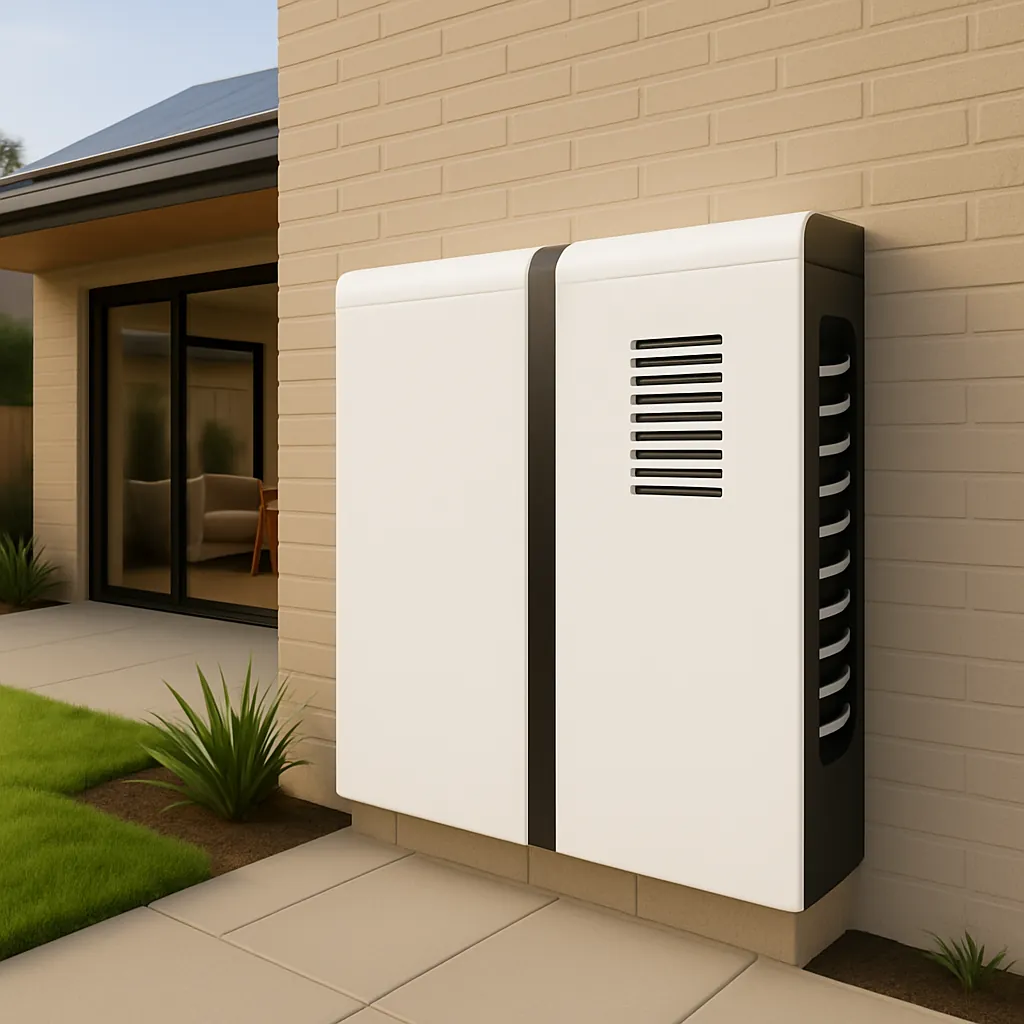
It's the first question on a terrace or a tight side passage, and it's a fair one. The outdoor unit is 450mm deep and sits about 150mm off the wall, so allow around 600mm out from the wall face, plus clear air in front of it to breathe.
Height is more often the constraint than floor space. If the obvious spot is under a window or hemmed in by a fence, mounting the unit higher on the wall solves most tight sites, and it keeps everything clear of paths and garden beds.
The thermal store is a separate insulated tank and can sit inside or outside, anywhere there's a sensible run back to your existing pipework. It comes in two shapes, which is often what saves a tight spot:
- 250L, cylindrical: 600mm diameter, around 2m tall. Small footprint, but it needs the head height and a path to get it in.
- 500L, rectangular: 500mm deep, 1300mm wide, 1600mm tall. Lower and wider, which usually suits a garage wall, a laundry, or anywhere with a lower ceiling.
Side passages, garages, laundries and under-house spaces all work. Which size you need comes out of your heat load, and where one shape won't go, the other often will.
Not sure? Send a photo of the space with your quote request and we'll tell you before anyone visits.
It Learns. It Optimises. It Just Works.
Thermal Dawn's control system manages all of this automatically, forecasting solar generation, reading your tariff schedule, modelling your home's thermal behaviour, and adjusting charging depth and timing every day without any input from you.
Over time it builds an increasingly accurate model of your specific home, how quickly it heats up, how well it retains heat overnight, how demand changes with the seasons. Every decision gets better the longer the system runs.
For those who want deeper control, Thermal Dawn integrates natively with Home Assistant and exposes a full open API. For everyone else, the app shows you what's happening and what you're saving, and the system handles the rest.
What to Expect, From Quote to First Winter
You don't have to wonder what you're signing up for. Here's the whole path:
- Free site assessment: we confirm compatibility, placement, and capacity, and answer every question. No obligation.
- Fixed quote: a single installed price with no surprises. Nothing to pay until you approve it. Reserve your place in the queue with a fully refundable $190 deposit.
- Unit build & order: your system is configured and built for your home. (Current lead time: 6–10 weeks.)
- Install day: most homes are done in one to two days. We remove your old gas boiler, install the thermal store and heat pump, and connect to your existing pipework, with electrical connection completed by a licensed electrician, then commission the system across every zone. Homes with more complex pipework or a switchboard upgrade may take a day longer, we flag that in your quote.
- Your old gas system: we remove and dispose of the boiler. A qualified, licensed plumber caps the gas line, arranged through us or by your own tradesperson. Disconnecting the gas meter to cut the daily supply charge entirely is optional, we'll walk you through whether it's worth it for you.
- First winter: the system learns your home and gets more efficient as it goes. We're on hand through the first months, direct engineering access, not a call centre.
Ready to See How It Works in Your Home?
Every home is different. A free site assessment gives you a complete picture, compatibility, placement, expected savings, and a fixed quote with no surprises.
Frequently asked questions
How long does installation take?
Most homes are installed and commissioned in one to two days. Homes with more complex pipework, extra zones, or a switchboard upgrade may take a day longer, we flag this in your quote after the site assessment, so there are no surprises.
What happens to my old gas boiler and gas connection?
We remove and dispose of your old boiler. A qualified, licensed plumber caps the gas line, arranged through us or by your own tradesperson. Disconnecting the gas meter entirely (to cut the daily supply charge) is optional; we'll help you weigh whether it's worth it.
Will my switchboard need upgrading?
Some homes need a switchboard or electrical upgrade to run the heat pump; many don't. We check this at the site assessment, and any upgrade is carried out by a licensed electrician and included in your fixed quote, so the price you approve is the price you pay.
Do I need three-phase power?
Not necessarily. Many homes run comfortably on single-phase. Larger homes or higher-capacity systems may need three-phase, we confirm this at assessment and tell you the options and any cost upfront.
Do my radiators need replacing?
Usually not. Our R290 configuration runs at up to 70°C, which is what most gas boilers actually deliver, so existing radiators generally work without resizing. We measure your specific setup at the assessment. Here's the flow-temperature question in full →
Who can service it, and what if you're not around?
Thermal Dawn is built from standard hydronic and refrigeration components, so any licensed HVAC technician can service it. There's no proprietary lock-in, no special parts to order from us, and no service contract you're tied into. We're happy to be your first call, but you're never dependent on us being the only one.
Will it fit on my block?
Usually. The outdoor unit is 450mm deep and sits about 150mm off the wall, and tight sites are often solved by mounting it higher. The thermal store can go inside or outside. Full clearances above →
Be There at Dawn
The first installs are done and running; the next spots are open now.